
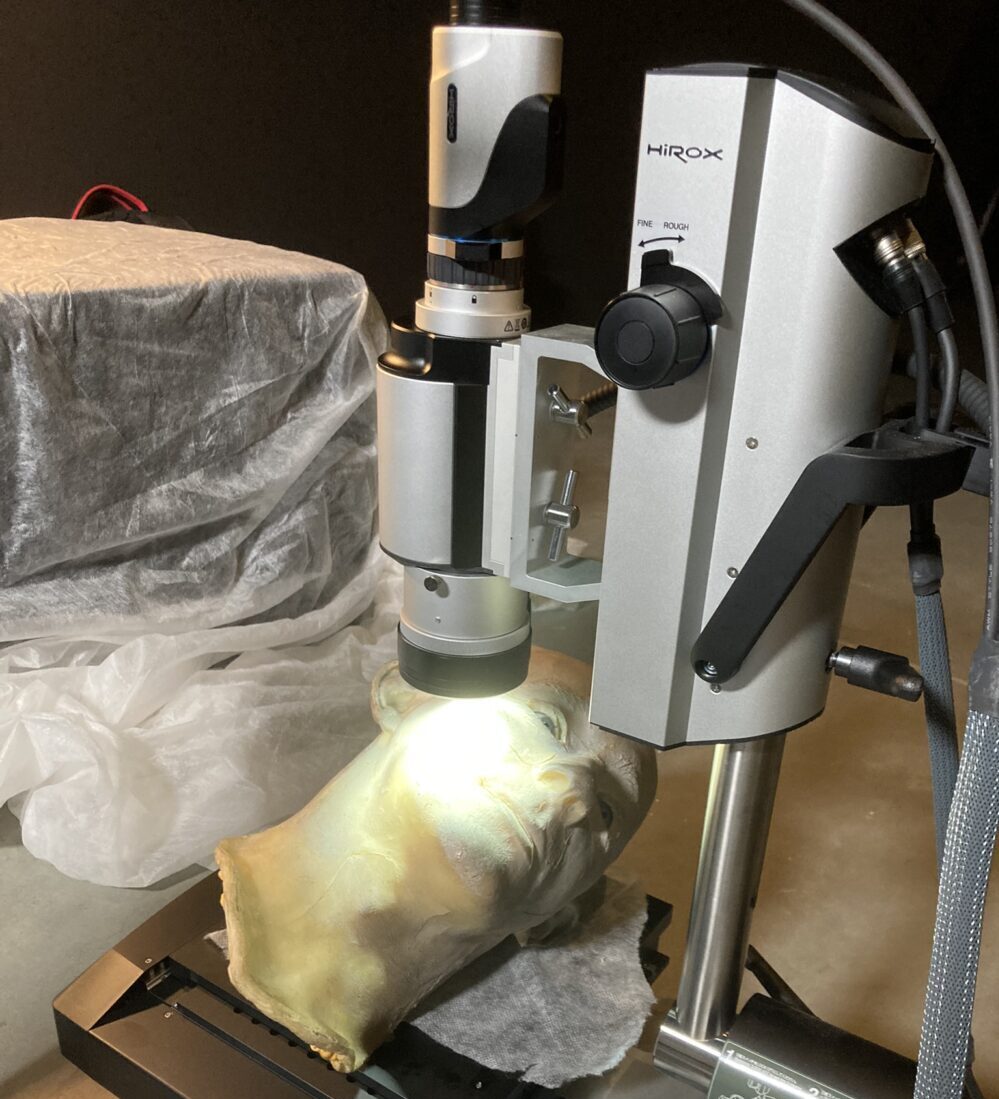


As part of the project “Preventive Conservation Strategies for Poly (vinyl chloride) Objects – PVCare”, we were asked to perform a microscopic scan of objects belonging to the CRICOTEKA collection.
CRICOTEKA is actually the the Centre for the Documentation of the Art of Tadeusz Kantor, who was a Polish painter, director, stage designer and art theorist who lived and worked in the 20th century. CRICOTEKA has an extensive collection of objects, including mannequins, related to the theater performances staged by Kantor. Unfortunately, made of polyvinyl chloride, they show signs of the ongoing process of degradation after such a short time from their creation.
Our goal was to document the condition of the objects, necessary to assess the development of changes, and to provide an opportunity to look at the damage at the microscopic level. It was a great pleasure for us to spend several hours surrounded by CRICOTEKA employees and their collections, and in our hands were:
– “The Machine of Torture” – replica / second version, object related to the play “The Water-Hen (Kurka wodna)”;
– “Children at their desk” from ” The Dead Class (Umarła klasa)”;
– and the right hand of “A boy at his desk” dummy from “The Dead Class (Umarła klasa)”.
In addition, we received two objects for further research.
The project is funded through the OPUS-LAP 20 programme in collaboration between NCN (National Science Center, Poland, project no. 2020/39/I/HS2/00911) and ARRS (Slovenian Research Agency, project no. N1-0241). People and institutions involved are:
– Jagiellonian University, Poland (Krzysztof Ryszard Kruczała),
– Jerzy Haber Institute of the Polish Academy of Sciences, Poland (Łukasz Bratasz),
– Heritage Science Laboratory Ljubljana at UL Faculty of Chemistry and Chemical Technology (Matija Strlič, Irena Kralj Cigić),
In collaboration with:
– CRICOTEKA – the Centre for the Documentation of the Art of Tadeusz Kantor, Krakow,
– Muzej za arhitekturo in oblikovanje, Museum of Architecture and Design, Ljubljana,
– Centre Pompidou, Paris.